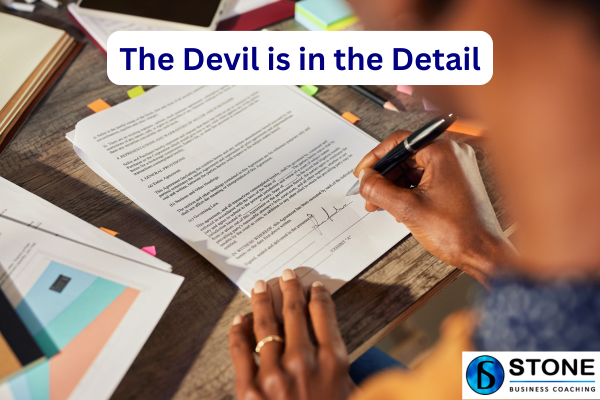
A good friend of mine, who is an experienced Finance Broker, uses this expression all the time – ‘The Devil is in the Detail’. It applies to so many aspects of our personal and business lives. When we miss little details, which turn out to be not so little, that is when problems (often quite large) appear. Too often people skip the details, don’t look or maybe even figure it doesn’t really matter. The following are 7 examples of where the details do matter and do have an impact.
Check the Details Thoroughly
Things are Not Always as They are Portrayed
This is a prime example. I was on a well-known global shopping site and when I searched for an item incognito, it came up as one price (Aussie dollars, in both cases, that wasn’t the difference). When I logged into my profile, where I’m supposed to get ‘free postage’ as part of my membership, I discovered the price in my profile was higher than in incognito mode by the postage amount. So, it’s not really free postage. That leads me to another thing; if you are shopping online, be very careful, as sometimes things are shown in USD and not AUD, which means you’ll be paying heaps more than you expected.
Read the Fine Print
I’ve read many a fine print over my decades of business coaching, and life in general, and I can say that frequently, when you read the fine print, you definitely think twice about proceeding. Most recently, I was wondering about buying a ticket in a campervan raffle. I checked out the company, and yes they are legit, so thought that’s ok. But when I read their T&Cs there were so many very specific clauses, time limits and conditions, that I thought, you know what, just not worth proceeding. In fact, what was shown as being the raffle prize was completely different to what was in the T&Cs. Maybe an error on their part, not bothering to update or possibly some misdirection? I’ve read franchise agreements where the terms are completely unfair to the franchisee with the worse one being that you had to pay a renewal franchise fee every 3 years, based on what they valued your franchise at! Ouch!
On a similar note, if you’re talking to a salesman, and then get a contract, and there is a conflict of information/advice, don’t take the person’s verbal advice as fact. Generally, it’s what is written that you take as fact; so if there is a conflict, get the contract or offer updated to reflect what they said. In a court of law, it’s all about documentation (the details), not who said what.
Contracts & Quotes
You submit a quotation where your terms are outlined. Possibly 14-day trading terms, or some other important detail which will matter for your business. However, if you’re working with an organisation who provides you with a contract, read what you’re signing before you sign AND ensure that their terms don’t conflict with your quote. I’m not a lawyer, but I suspect that the later-signed document (the contract) would take precedence over the prior quotation (which they probably didn’t even sign, you just submitted). Or if you’ve viewed a contract, then it’s been taken away and amended, review the whole document again; just in case something else was also changed. Always be on the lookout for hidden fees or hidden penalties. The devil is in the detail!
Auto Renewals
These can be sneaky. You think something is a one-off, but it’s not, and too often they auto-renew without telling you in advance. Instead, they advise you after the fact, then it’s too late to say “No, I want to stop that”. I highly recommend that you double-check these things as you’re initially paying and if you know it’s an auto-renewal, then put that in your diary about a month earlier; in fact, I often check as I’m signing up how and how far in advance I can cancel. The diary note contains that info whilst it’s handy to find.
Financial Accuracy & Scam Payments
Financial inaccuracy can impact in so many ways. Coding years of commercial rent non-GST instead of GST makes a huge difference to your claim of input credits on your BAS. A lost decimal point can make a difference, especially if you were meant to pay a supplier $126, and instead sent them $12,600. Wrongly coding a capital injection as sales and GST, not only increases income, tax on income, overstates GST, but it also means that you, as the owner, are not credited for the funds you injected into the business. It’s a three-way lose/lose/lose scenario. If you wrongly date an expense bringing it forward into a prior BAS period, can be seen by the ATO as GST fraud.
Still onto the details, you get an invoice from a supplier, but you don’t take the time to check the details, get authority to pay, or just accept the bank details without confirmation, and suddenly you’ve sent $30K to a scammer’s bank account.
Payroll Accuracy
Lots of things can go wrong here if you’re not accurate. You might not correctly pay overtime, or perhaps use the wrong level of pay rate for a staff member, essentially underpaying them, as they might be a level 3, not a level 2. You might miss allowances, or in some cases, the bookkeeper doesn’t track annual leave taken. It’s just paid as ‘normal time’ so when that employee leaves they would get paid out far more annual leave than they should because leave taken was never actually recorded. Errors can work in both directions, but shouldn’t because mistakes in payroll can have serious consequences, particularly if an employee makes a claim to Fair Work Australia.
Legal Issues, Banking & Insurance
As I’ve said before, I’m not a lawyer, but if you’re unsure about a legal document, contract and especially if you’re entering into a franchise agreement, engage a lawyer. People sometimes think about the cost, but think about the cost if you make a fatal mistake. It could cost you your business, your home or a huge chunk of money; likely far more than the lawyer. And no, not on commission to spruik lawyers! 😊
Another example is that you might be a food manufacturer and if your label is found to be inaccurate, you can be on the receiving end of lots of penalties. Or worse, a lawsuit; say if you forgot to mention trace components of nuts might be found, and a nut allergic person ate your product and nearly died.
Another classic example is insurance. Even if you have a broker, check the details. You might not be covered for floods or storms, or there is a massive age excess if the driver is under 25, or potentially even your insurance is voided because U25’s shouldn’t even be driving your car.
If you use online banking, and often after an update, the bank has updated the conditions of use. Before you can proceed and do your online banking, you have to tick ‘yes’ to their terms and conditions. I would bet that less than 1% of people read those T&Cs first – the bank ‘banks’ on this I’m sure, knowing you’ve no choice, people are in a hurry, will accept the updated T&Cs … and who knows what is slipped in?
So, as you can see, there are many, many instances in every aspect of our lives where details do matter. Whether you’re shopping online, buying insurance, purchasing a business, or simply selling some jam at the markets, you have to be very careful with so many details. Re-check things, engage professionals to check for you, assume nothing and never just take someone’s verbal advice “she’ll be right mate” because that isn’t a legal defence.
For business coaching needs, check out the services I offer. You may find one that fits your requirements. For complimentary sample coaching, click the link.