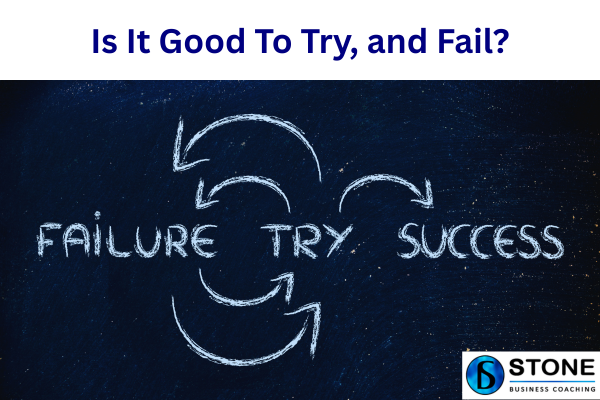
Is it good to try, and fail? Now, what’s important in this subject title is the location of the comma. I’m not talking about trying to fail, but rather, trying, but not succeeding (failing). As an experienced business coach, I’m not a fan of failure. Sure, some pretty notable people have failed and then bragged about why it’s so great. And yes, there are some good lessons from failure; however, I prescribe that we learn from others’ failures, and simply avoid failing ourselves in any big way.
Here are 5 (initial) Failure Stories – But What The Lessons Were
J.K. Rowling, the author of a best-selling book series with over 600 million sold, was a jobless, single mum on welfare, living in poverty and suffering depression when she wrote her first Harry Potter book. This lesson here is about mindset. I don’t know her, though her mindset could have been ‘I’m not doing well, so why bother?’ Needless to say, she pushed past her situation, to write a series of books which is phenomenal in their success. A true icon of resilience.
John Grisham, another very well-known author, was rejected by not 3, not 6, but 31 publishers and agents with his first book. I’ll bet some of those publishers are kicking themselves now! But the point here is that John didn’t quit, he didn’t accept rejection or failure, but persisted and tried, tried again. He’s written now 37 successful books, a number of which have been made into movies. His first book ‘A Time to Kill’ starred Sandra Bullock, Samuel L. Jackson and Matthew McConaughey; all big names in their own rights. I think it’s safe to call him “Mr Keep Trying”. Imagine had he quit after the first few rejections, went home, put his book on the shelf and simply stayed in his job.
Winston Churchill, a wartime leader and Prime Minister of Great Britain in WW2, finished last in his class. He struggled academically, was often in trouble and teachers considered him ‘backward’. As I read his profile, I wondered to myself, did he have ADHD? It was never diagnosed, but there is that speculation. Often people with ADHD, despite their struggles, have very high IQs. They are often ‘street smart’ and intelligent; they just don’t do so well in mainstream school. The message here is that you can do not so well in one area and absolutely excel in another. I know business owners who barely passed school, but have gone on to be amazingly successful in business. Kudos to them for leaning into their abilities and leveraging their strengths, rather than focussing on the negatives. Remember, if you have a weakness in one aspect of your business, you can get someone else in who is good at that, whether it’s organisation, marketing, or money.
There are 32,000 KFC stores globally, but the Colonel failed to sell his recipe to over 1,000 restaurants initially. The reasoning for these ‘failures’ was that his pitch was wrong, he wasn’t targeting the right market, and the recipe seemed too complicated. Whether you’re a fan of KFC or not, the lesson here is that if you strongly believe enough that what you’ve got is great, but it’s not working as is, then listen to the feedback and change how you’re doing things. Quite a few businesses over the years have tweaked how they do things. They drop products, add services, and move from traditional storefront to online. It’s about staying the course as a business, whilst still evolving. Often in business, we need to be flexible and adaptable, whilst not quitting and being resilient. KFC today is the second largest franchise in the world, only second to McDonald’s; going from massive rejection to global dominance. And for a little trivia, the country with the most franchises/stores in the world is China!
Closer to home, let’s look at Billabong. In 2013, it had $860 million in losses, however, with a range of strategies, it was able to turn things around in a few short years. Strategies including simplifying things and closing stores (or dropping labels) which were not doing well. It improved with brand and marketing and better understood its core customer base, whilst implementing a better customer-centric approach. And finally, Billabong utilised technology that allowed for a better and smoother customer experience, improved systems, better management and administration. Here, my lesson is to change and adopt better practices, which are often technology-based. Too often I go into a business to see multiple apps or platforms being used, not synced and therefore things having to be done multiple times, or ‘the hard way’. At times I will ask “why is this being done in this way” and the answer is simply, “Well, it’s the way it was always done” … even if ineffective or downright wrong.
Sometimes people see business coaches who are people who work with failed businesses, and yes, often we do. However, there are such varying levels of failure. Not having one of your email newsletters generate a single prospect could be considered a failure, but will it create a $860 million loss? Losing a single customer because you let them down could be considered a failure, however it also represents an opportunity to learn from that mistake, change things and get it right. If the ‘let down’ was perhaps an error on the part of a team member, can the processes, systems and staff training be improved?
These little failures are great opportunities to learn, improve or tweak what you’re doing. That’s where I come in as a business coach. I’m about looking at the one-percenters and finding a hundred ways to improve a business. Even better is where I use my decades of experience to anticipate where things could potentially go wrong, be proactive and actually address a problem, before it even becomes a problem. You don’t need it to get to $860M loss, or bankruptcy, or closure – but rather at every turn, you’re looking for opportunities to improve. Mini failures are gold if you look, listen and learn from the experiences. Jump in and correct things well before a small incident becomes a massive event.
Essentially you should:
- Plan well and do your due diligence – so that you know the path you will take will be the right one. I don’t advocate just jumping in without thought or research, but once you’ve done that, and planned your approach, then give something a red hot go. Something new can sometimes be uncomfortable and there is risk, but as long as that risk is calculated and well thought through.
- Try – and keep trying. I wonder how many people quit a second before they were about to succeed? Embracing a resilient mindset will certainly take you a long way. Or worse, had a great idea, thought or concept and just didn’t even try to get it started. If you’ve done your due diligence and it’s got a good chance, then failing to start sounds like failure too.
- Tweak and improve as you go – every day, if need be. If something can be done better, why not do it better? It’s called improvement.
And yes, accessing an experienced business coach like myself to do all the above more effectively can have a massively positive impact. As I said, I love learning from others’ experiences and sharing (of course, confidentially) that experience so that each and every one of my clients can keep those mistakes and failures super small, and never allow the big failures to happen. I’ve learned a heap in over three decades of helping business owners – knowledge I love sharing with clients to help them have greater success. If you’d like to access a free ½ hour sample coaching session – reach out HERE. My passion is your potential.