Interestingly, two people this last week mentioned they were suffering from forgetfulness and ‘brain fog’. I know one of these people is fatigued, but it did get me thinking that this might be a great subject to write about. In my decades of business coaching, these two mentions are by no means the first time I’ve heard this; I’ve heard it quite a few times. Over COVID it was a common complaint, but it’s also prevalent as people get older, are stressed or simply, have waaay too much on their minds.
Here are some super practical tips to help with successfully managing forgetfulness, and even if you forget nothing, they are often good practices in life and business.
Lists
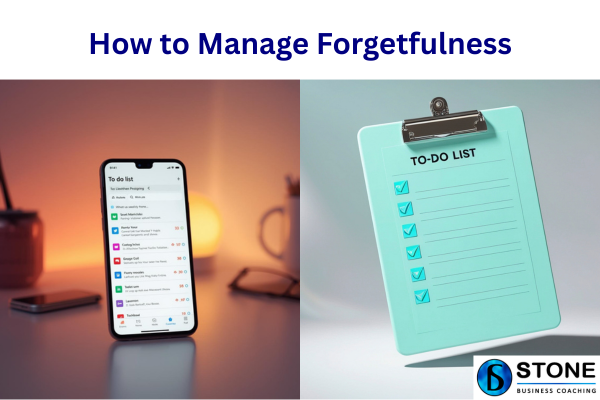
Who hasn’t gone to the shops without a list and come back without something they needed? We get distracted, bump into someone we know, or simply forget. Lists are fabulous to ensure we don’t forget to do something. Whether it’s for shopping or things to do. Most lists these days can be on our computer or phone – there are a tonne of options. I particularly love Microsoft’s To Do List which is a free app, but which can be linked to Tasks. Apple phones also come with Reminders, which works fine, although I aesthetically prefer the look of the To Do app.
Systems
Having documented systems and processes isn’t just about making sure that things are done in the right way, by the whole team, but it also means important steps are not forgotten. Work out the best way of doing something, then document it, teach your team and encourage (ensure) everyone follows the process.
Checklists
Checklists and templates are my best friends. I love them for many reasons. Mostly because myself and my team don’t have to think about a process, it ensures no important steps get missed, but it’s even better than a system, because the checklist is in front of you. Even if you’ve been in the business a decade and know a system without looking at it, checklists are designed to be used at the time of the activity, whereby you tick off as things are done. Easy on the brain and ideal for the business as fixing mistakes, apologising for poor service or rectifications simply costs a business, and its reputation.
Reminders & Diary Prompts
It’s pretty hard to forget an appointment or important activity, or even a family member’s birthday, if you pop it in your diary with clear reminders. Ensure you take a moment to do it correctly, double check the details, for example, you’ve set the appointment for 4pm, not 4am and have the correct date. Once the details are in, then you can relax and let the reminders help you. If you need prep time (such as with a birthday) then set the first reminder, say 1 week prior and then the second reminder for the morning of the event.
Routine
This isn’t just important for people with dementia, but it’s great for all of us. With routine, we do things automatically and in a systemised way. It reduces stress and often activities become muscle memory. Think about brushing your teeth. Do you ever forget to spit out the toothpaste? It’s something we’ve been doing for decades, most likely in exactly the same way. Here is a mind challenge, try brushing your teeth with the other hand! It’s not as easy as it sounds. 😊
Save Harder Activity for Early
Work on important things early in the day, when you’re most likely fresh. Most people (but not all) are morning people, so it’s a great idea to work on the ‘brain drain’ type tasks when we are fresh. Keep the easy, automated or simple activities for the end of the day when we’re feeling tired, fatigued or a little worn out.
Reduce Multitasking
From a time management perspective, multitasking is not a good strategy. In fact, when I’m teaching groups, or talking to business coaching clients about smart time mastery, I specifically advise against multitasking. Long story short, our brains work most effectively when we are focussed on one thing; so, if you’re struggling a bit with memory, then multitasking is one of the worst things you can do.
Get the Right Mindset!
Don’t tell yourself you’re forgetful as it’s a great way to teach ourselves that we are. Just like children, we believe what we are told. Telling yourself that you’re something is a sure way to become it. I’ve had clients who say they are “shocking with technology” or “hopeless at names” or “lousy at sales”, and guess what, keep that mindset and you will be. Change that mindset right now, and focus on improving and getting better, not holding yourself back!
Good Health
Along with a healthy mind comes a healthy body. Exercise, nutrition and getting good quality sleep are all components of a healthy body, which then often flows to a healthy mind. Instead of starting your day on your phone, Facebook or TV, start with exercise, a walk with your four-legged friend, or meditation. Your body and mind will be better for it.
Everything Has a Spot
I’ve got friends who can spend an hour hunting for their keys or phone – so much to the point of getting tags so they can find them. First, try having a spot for everything. This somewhat comes back to habit. If you consistently put your keys in the same spot, you’ll most likely be able to go to that spot and find them immediately when you go to leave for the day. Phones, wallets and glasses are a little harder, but again, think before you put something down. Glasses can be put in your shirt front, or on your head (just remember to feel for them on your head, which you will if you develop a habit of doing this).
Declutter
When your environment is neat, tidy and not cluttered, then this tends to pass onto your mind and brain. Keeping things tidy and organised often helps you have a tidy and organised mind. If you’ve got a mess, especially in your office, take a day off to do a massive clean-up. Get rid of the things which you don’t need. I recently tidied my office library and ditched the 1998 Excel Manual I had created for classes I’d run decades ago. Get ruthless and toss what you really don’t need or has expired. You may need to get some storage boxes, shelves, trays or folders to get things organised. Invest in these items so you can have a clean and tidy workspace. This will not only help with reducing mind clutter but will make you more efficient as you’ll be able to put your hands on things much faster.
Download!
Above, I talked about physical decluttering. There is also mind decluttering. If you’ve got a thousand things on your mind, then write them down. It might be a Christmas gift list, things to do, people to call or blog ideas. Write them down and get them out of your head and then you can relax. Plus, psychologically, it feels like you made more room in your brain for other things.
In Summary
Forgetfulness happens with all of us, regardless of age and for many reasons. The above ideas, I hope, will give you a number of strategies to implement. If you think you might forget some of these ideas, then print off this blog and keep it somewhere you’ll come across regularly to refresh. On the other hand, if you are seriously concerned about your memory, talk to your Doctor. Sometimes it can just occur, because of pain meds, illness, fatigue or special circumstances, such as pregnancy, where ‘baby brain’ is a common occurrence. Yep, I almost put my car keys in the freezer during one of my pregnancies. 😊 Remember, as a business coach, I help clients with all sorts of practical things, which go beyond money, marketing, operations or team – such as soft skills like mindset, time management and yes some of the ‘challenges’ we often face, but rarely tell others – such as forgetfulness. So, if you need help, remember to reach out to me here. Yes, pun intended. 😊