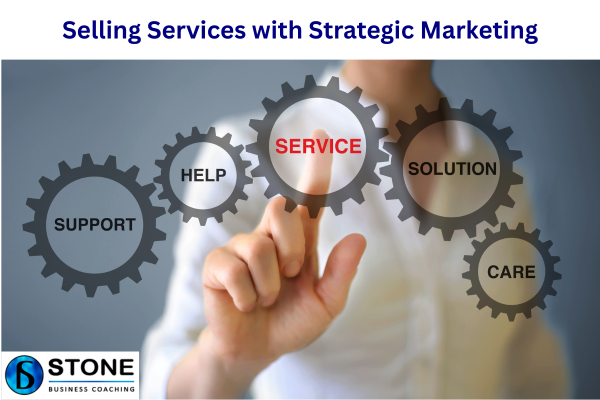
Selling the ‘intangible’, which is what services often are, is harder than a product. Unlike a piece of furniture, or a car, or a jumper, there is nothing physical that you can touch, feel, or photograph as such, but services (usually something you can’t feel or touch) can be sold very effectively. You just need a slightly different approach.
Interestingly, since post-COVID, more and more physical items are being sold online, which means you can’t touch or feel them. Physical products being sold online often adopt quite a few of the following principles. Especially now, online or service-based businesses have even more competition. With the move to online and digital, many products and services can be purchased from anywhere in the world. Yes, this opens up your market, but it also opens you up to more competition. Here are some practical tips to get strategic with your marketing of online products or services, or selling the intangible service-based product. Naturally, this globalisation won’t apply to physical services, like tradies, construction, cleaning, which occur at a location; but it definitely has opened up websites, graphic design, bookkeeping and yes, business coaching.
Strategic Marketing for Selling Services
Be Clear About the Benefits and Why You’re a Great Choice
When you’re the cheapest, then you can sell purely based on price and focus on budgets and the economy of the choice. In fact, pricing will be a major aspect. However, let’s assume you’re not the cheapest, then you want people to base their decisions on more than price.
For this reason, you need to be very clear and succinct about what you offer and why it’s a great (if not best) choice for the prospective client. Clients should not need to hunt for this information; it should be front and centre and easy to digest. Talk about your local expertise, or decades of experience, skills, qualifications or results you’ve achieved. This should occur on your website and social media pages, but also in what you write or say, such as in blogs, videos or podcasts.
There is an expression I love: make it easy for someone to give you money, give you business or do you a favour. On the sales side of things, make it easy for them to choose you … then work to make it easy for them to come on board and become a client.
Remember also, although your business or service may not be tangible, your marketing and sales material will be; whether it’s a digital flyer, physical brochure or business cards – make sure the tangible reflects well for you.
Build Trust Through a Range of Strategies
Your very first strategy is to be found and found in multiple places. This means, of course, having a website, plus social media profiles as well as other online profiles on quality sites. The more you are able to be found, the more trust you build. Now I specified here, quality sites. Having backlinks (listings) on dodgy or irrelevant sites does not help your SEO and does not build trust.
Another trust-building strategy is social proof through reviews and testimonials, which are found on your website, Google profile, Facebook or LinkedIn profile and in your marketing. Reviews are gold; I’m often showing business coaching clients how to earn, get and use them effectively.
Don’t forget the expert strategy as well. Whether you’ve written books (I’m working on # 8 at present) or were featured positively on a reputable TV program or simply are able to say you’ve 20+ years of experience, this all goes towards the expert factor. Qualifications or expertise in a specific area also assist; it might be that you worked for a well-known company or headed a team that achieved something exceptional. Another strategy, often used with brokers or grant writers, might be a counter showing you’ve gained $6,580,000 worth of funding for clients. Or perhaps, you’ve provided inter-generational funding to families to help them buy their homes – parents decades ago, and now their adult children are coming to you to help secure their own home loans.
Naturally, a part of the trust-building stage is to actually build a relationship with the person you want to connect with. This can be done in numerous ways, depending on how contact occurs (online, in writing, over the phone or in person) and depending on what you’re selling. An example I used to use when visiting a client’s home (in my prior business) was to find something positive to comment about their home, or their children or pets. What a beautiful garden you have (if well-manicured), or show interest in their pet by asking questions about the breed, gender or age of the animal, or talking to a child, showing interest, what is your name? Allow the right amount of time; some people are people-focussed and will be happy to ‘shoot the breeze’ for a while, others are focussed and will want you to get to the point quickly. In other words, as the expression goes – read the room.
Make the Intangible Somewhat Tangible
When you provide a service which isn’t exactly tangible, such as business coaching, even accounting or say fitness – you want to focus on the outcome. Don’t just describe your service, such as we prepare tax returns, rather focus on the outcome – I help small business owners get more business, make more money, reduce their stress and improve their business overall. In other words: ‘results-focused business coach who helps clients achieve their full potential’.
Even a service business, like a tradie, needs to sell the intangible. Sure, a qualified electrician can fix a problem, but will they do it without ripping you off, overcharging, stuffing up something or voiding your insurance? Hence phrases like fully licensed, or trusted local tradie come to mind – along with the social proof you will also provide to remove any doubt as to how well you’ll get the job done.
Remove the Risk
Firstly, testimonials, results or case studies are gold. Whilst a case study is good, what others say about you is even better. Behind-the-scenes videos or podcasts build a relationship with the person and the potential client. Remember to not just chase these reviews but to share the ‘client love’ as I often call it – posting those reviews on social media, on your website or in your marketing materials.
Another way to remove some of the risk is a try-before-you-buy concept, or sampler. I offer a free 30-minute sample coaching session to see what I do, how I do it, and whether it’s a good fit for us both. This removes some of the angst around the business coaching services. Will I have the right advice, will you connect with me, or will you feel engaged? Many questions come to mind, and whilst testimonials are fabulous, it’s always good to get a taste test and see whether the fix feels right.
Another way to sample someone is to do a mini workshop. These are often tiny in price; enough to get the person to commit to attending (because if free, the no-show rate goes through the roof), but not so much of a deterrent that it’s hard work to get people on board. This concept is often called “selling from the stage”, where your objective is to upsell a percentage of your audience to the next level.
Communicate Well
Important in every aspect of sales (and business) is good communication. This starts with answering the phone, responding to emails, and having clear and open communication during the process. What can clients expect during onboarding (gosh, I do hope you have an onboarding process!), and how will you approach their job or project? Things like timelines, when you’re likely to be able to start, or who (and how) to contact someone if they have any queries. Don’t say ‘problems’ but rather, queries. All parts of your communication should be transparent and honest. If you know you can’t start the job for 4 months, then don’t take their deposit with a promise “we’ll get started real soon”. You want to offer reassurances, but within the realm of truthfulness.
Ensure, once you get the sale, that you not only onboard the client, but you keep up the communication. A customer says yes, pays the deposit and then is ghosted, is sure to raise red flags and very strong buyer’s remorse. Don’t allow that to happen; as prompt as you were in selling, be as good (if not better) at delivery. Customer service links with marketing and selling, so be sure not to just be great at selling and crummy at delivery and customer service. Check out this blog on the subject!
Finally, as with all aspects of business, ensure that all your team are fully trained. Even if they are not part of the sales team, they are likely having client contact, so they are points of contact and customer service is relevant. Or perhaps when you’re away and they step in to talk to a potential client, they are actually assisting in sales and need to know how to provide the service, pitch the message right and know where all the resources and templates are in respect of the sales process.
If you need assistance with sales, marketing, operations, team management and of course, all things financial in a business, reach out to me here as truly, my passion is your potential!